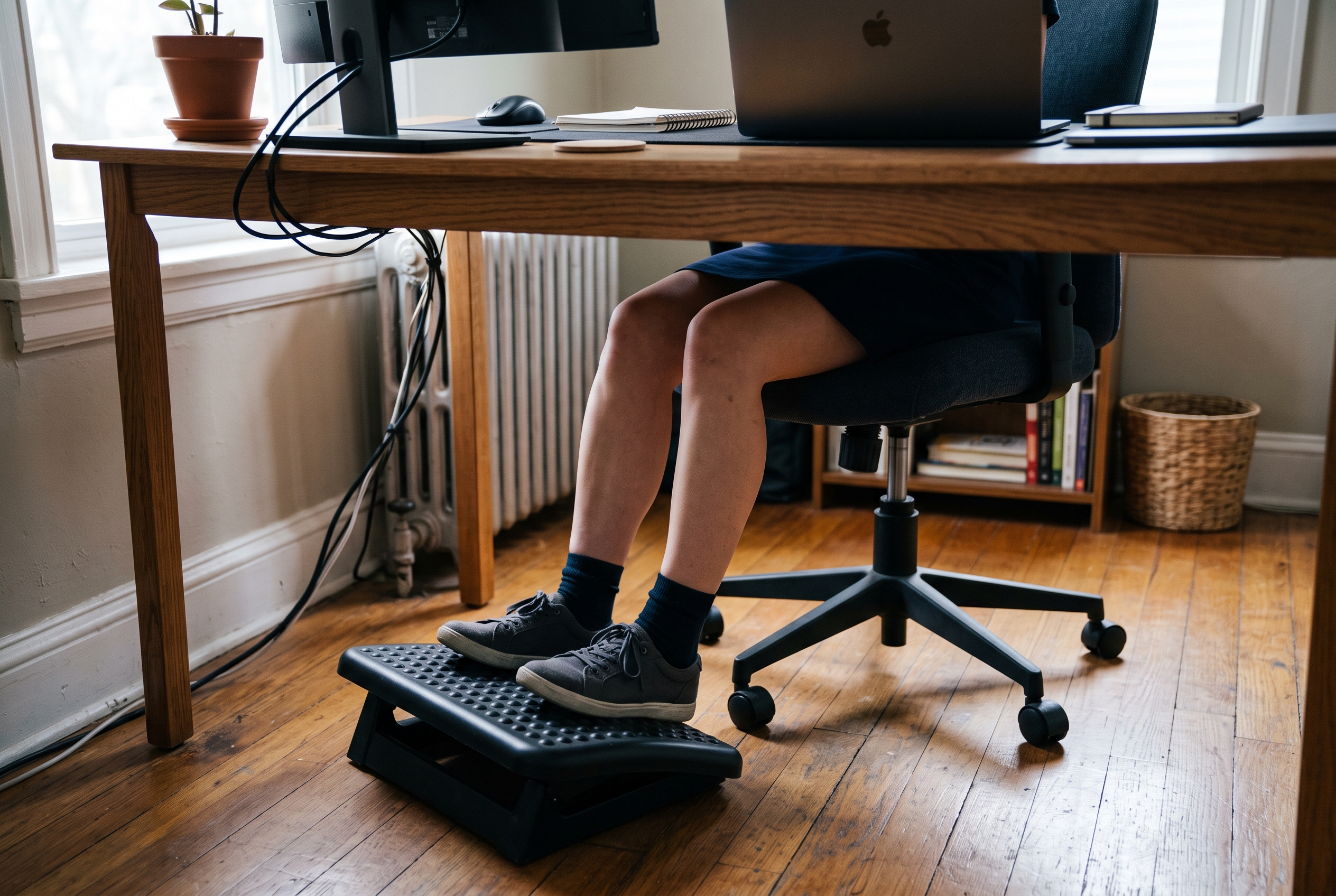
If you’re around 157 cm, your office chair probably bottoms out about 4 cm too high for your legs. That leaves you perched on the front edge of the seat, thighs sloping downhill, calves cramping by mid-afternoon.
A footrest changes that almost immediately: feet flat, knees at 90 degrees, lower back actually supported. Same chair, same desk, completely different body. If you would rather swing your feet than plant them, see our under-desk foot hammocks and swing footrests.
A footrest for a short person isn’t a luxury. It’s the missing link between a chair that won’t go lower and a desk that won’t go higher — and it costs less than a nice dinner. Below are five footrests compared for this guide, plus what to check before you buy.
Quick Answer
For someone around 157 cm, the Mind Reader Adjustable Footrest is the best overall pick — about 10 to 30 cm of height range, adjustable from a seated position, around $35. On a budget the HUANUO Adjustable Foot Rest (three fixed positions, roughly 12-18 cm) runs around $28, and when your chair is already at its lowest, the iMissiu foot hammock (around $25) hangs at any height.
Top pick: Mind Reader Adjustable Footrest — typical ≈ $35 · Check current price on Amazon
Comparison Table
| Product | Lowest height | Tilt | Material | Price |
|---|---|---|---|---|
| Mind Reader Adjustable | ~10 cm | No | Plastic | $35 |
| HUANUO Adjustable | ~12 cm | No | Foam | $28 |
| Fellowes Adjustable | ~10 cm | No | Plastic | $45 |
| ErgoFoam | ~20 cm fixed | 20° fixed | Firm foam | $50 |
| iMissiu Foot Hammock | Strap-adjusted | Yes | Fabric | $25 |
Quick Picks
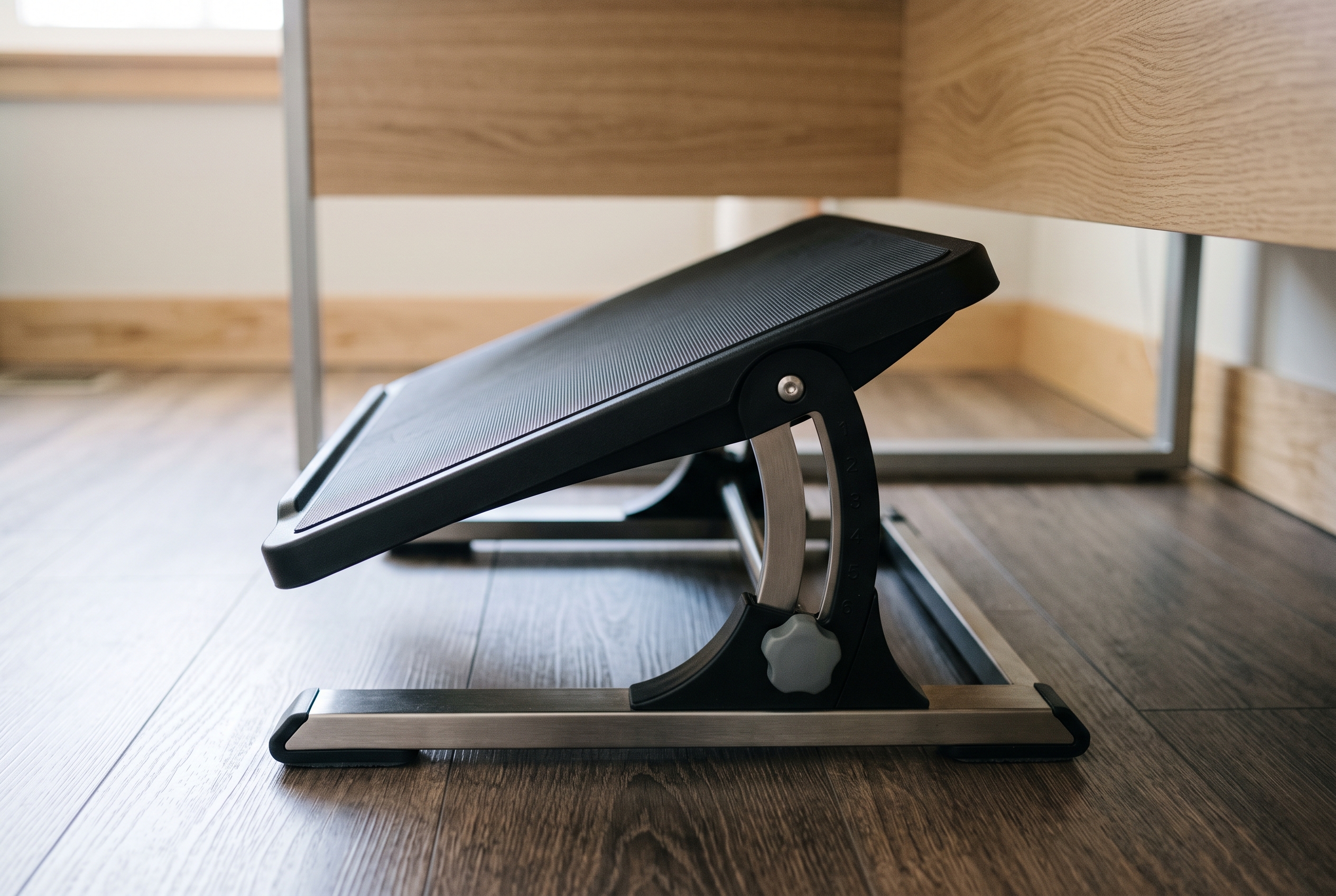
- Best overall: Mind Reader Adjustable Footrest — roughly 10–30 cm of height range, adjustable with a lever while seated. Around $35.
- Best budget: HUANUO Adjustable Foot Rest — three height positions and a massage surface, around $28.
- Best for the office: Fellowes Adjustable FootRest — four click-in heights from 10 to 25 cm and a base that never slides. Around $45.
- Best angled: ErgoFoam Footrest — a firm foam wedge that tilts your feet toes-up to ease calf strain, around $50.
- Best alternative: iMissiu Foot Hammock — hangs under the desk and works at any height. Around $25.
How We Chose
The comparison focused on a 157 cm user with a 74 cm inseam, working at a 140 cm desk with a chair that only descends so far. Four rules guided the picks:
- The lowest setting had to be genuinely low. Most footrests bottom out at 15–20 cm, fine for average heights but useless when your chair is already at its minimum.
- It had to stay put — checked against owner reports of sliding, tipping, or flex.
- Tilt mattered. A surface angled about 15–20 degrees toes-up relieved calf pull far better than a flat one.
- Owner reviews consistently mention surviving months of daily use, not just feeling nice for an afternoon.
Long-term owner reviews from users between 152 and 160 cm were also factored in.
Reviews
Mind Reader Adjustable Footrest — Best Overall
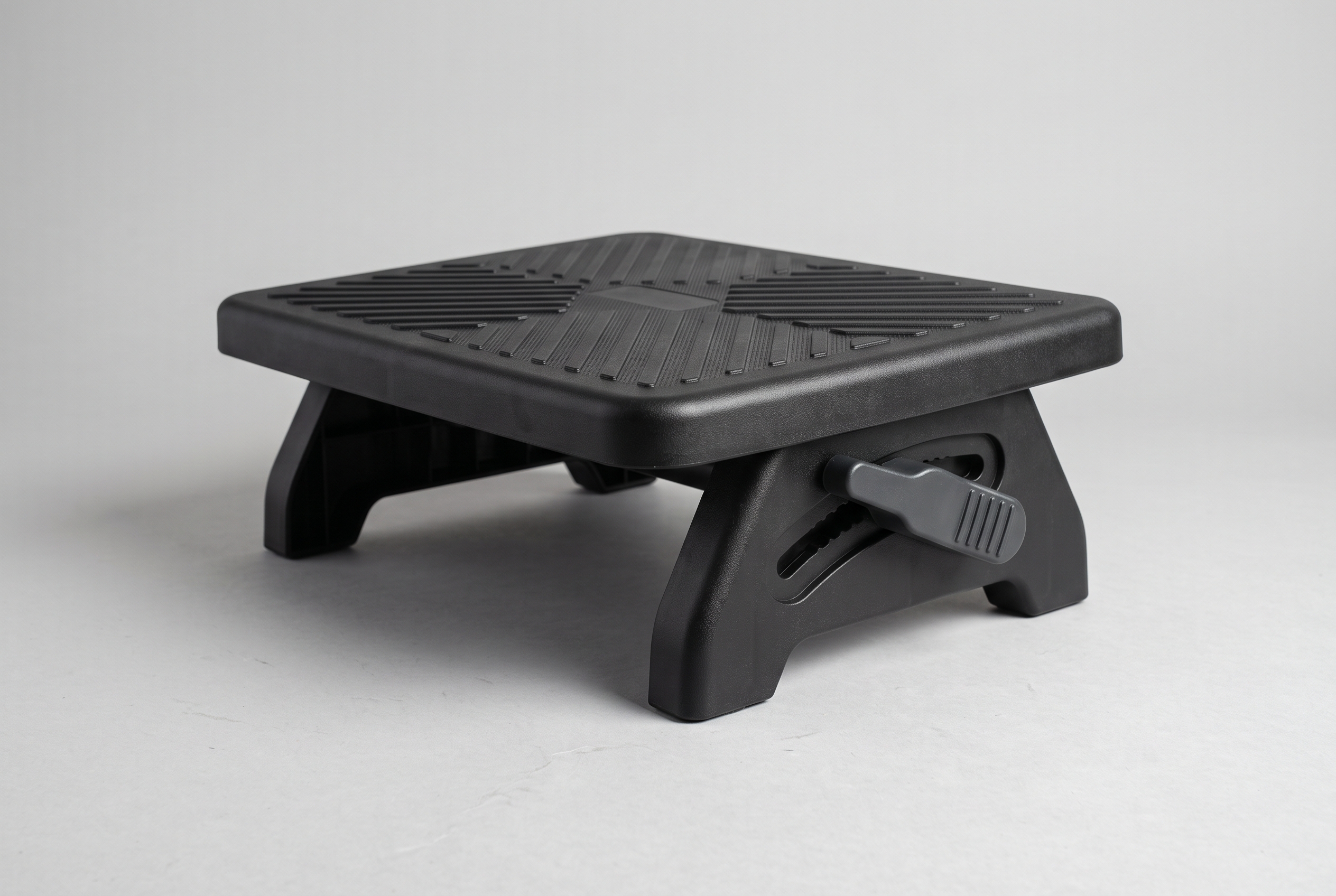
The side lever releases the height mechanism, so you adjust it while sitting — no getting up, no guessing. It spans roughly 10 to 30 cm, which covers nearly every short-person setup. The textured top grips socks without grabbing fabric. The most common complaint: a slight wobble at the highest setting. At about $35, it remains the most recommended pick.
Typical ≈ $35 · Check current price on Amazon
HUANUO Adjustable Foot Rest — Best Budget
Three height positions (about 12, 15 and 18 cm) and a ribbed, massage-style surface. It’s the softest option here — a relief in winter, when plastic footrests feel like blocks of ice. Two caveats: the height is fixed, and the foam softens over a year of daily use. If you need adjustability, the Mind Reader costs only about $7 more.
Typical ≈ $28 · Check current price on Amazon
Fellowes Adjustable FootRest — Best for the Office
Four click-in heights from about 10 to 25 cm, plus the widest base of the group. It didn’t move a millimeter on carpet or hardwood. The mechanism clicks loudly when you change height — annoying in a quiet room, but you only do it once a day.
Typical ≈ $45 · Check current price on Amazon
ErgoFoam Footrest — Best Angled
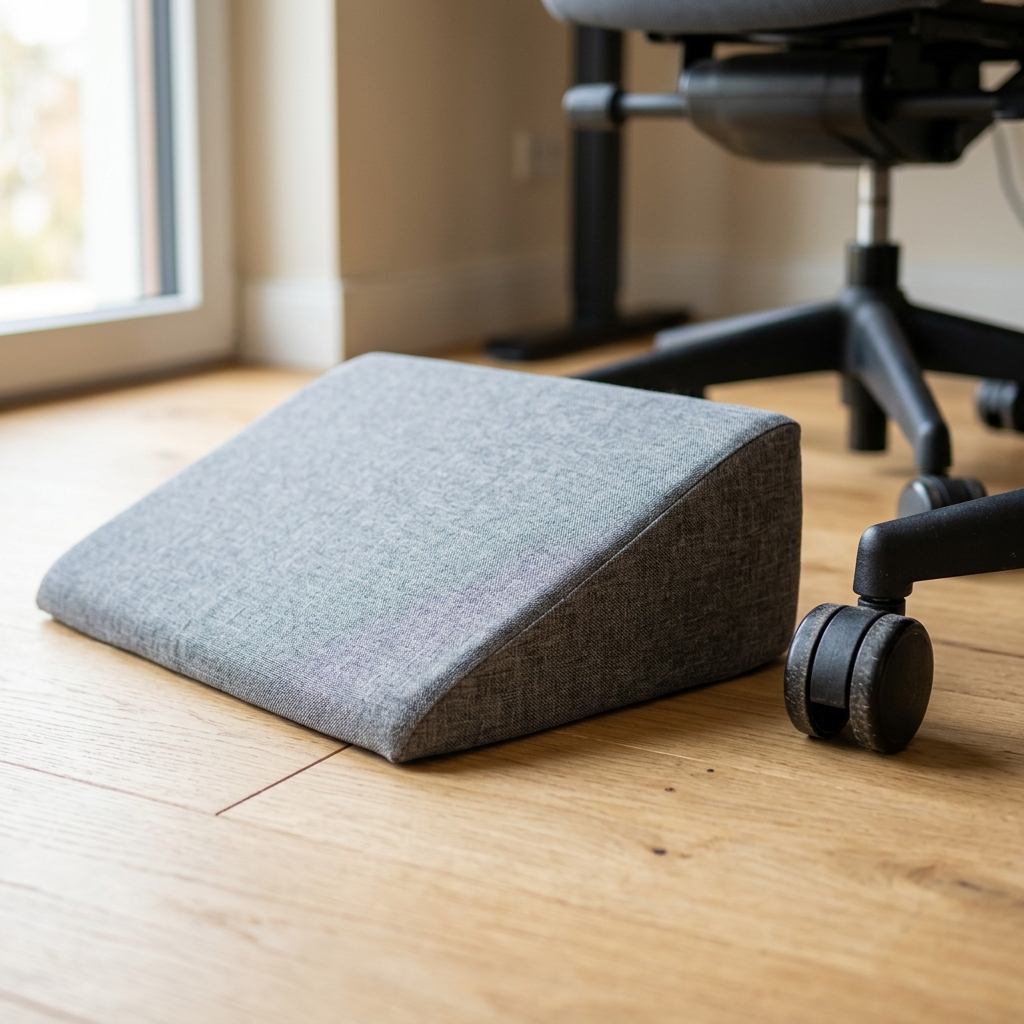
A firm wedge that holds your feet toes-up at about 20 degrees. For users whose calves ache from hours of dangling, this is the most commonly recommended fix. The height is fixed at roughly 20 cm, so measure the gap under your desk first. If your chair sits high, this wedge shines; if it’s already at minimum, the fixed height may be too tall.
Typical ≈ $50 · Check current price on Amazon
iMissiu Foot Hammock — Best Alternative
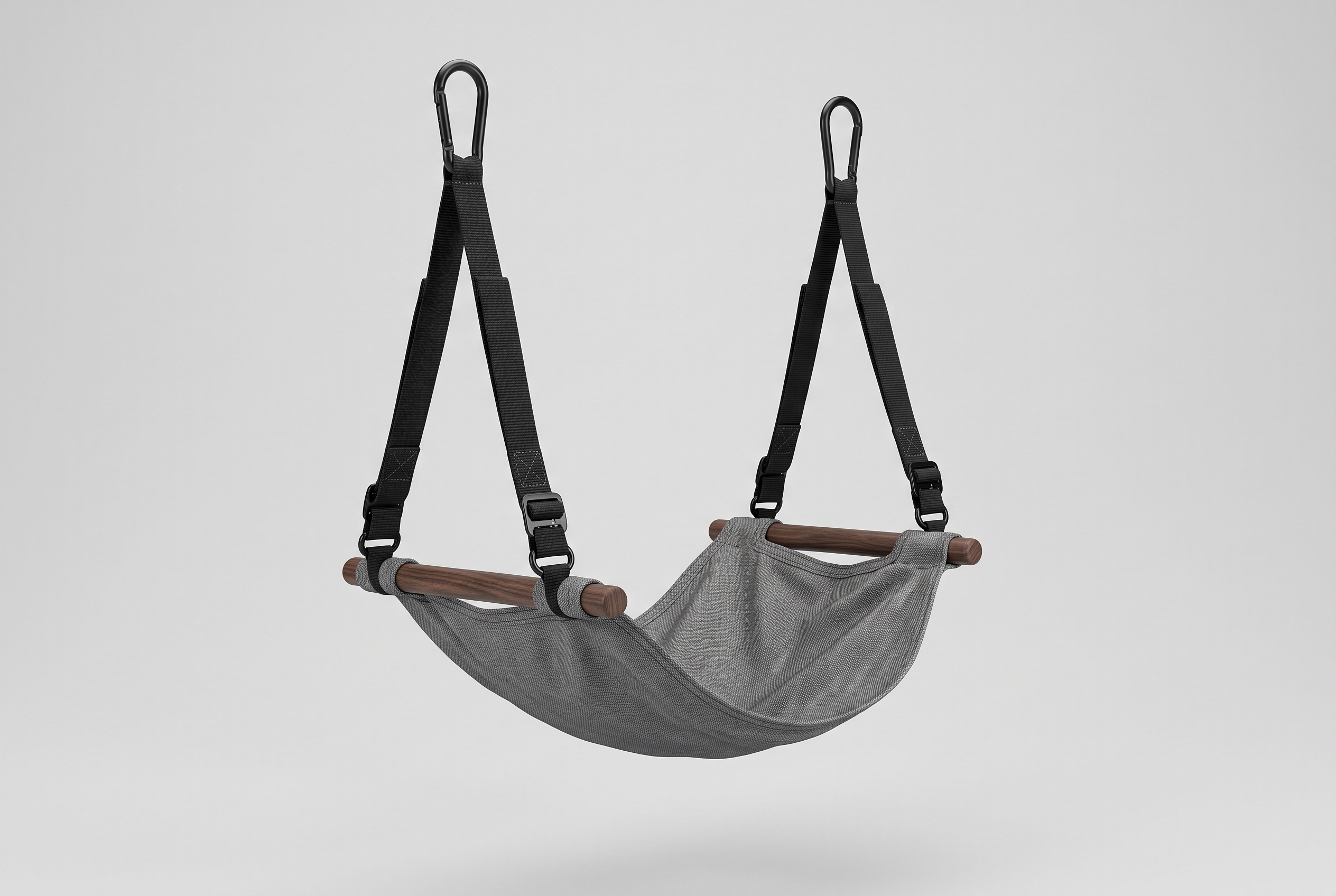
Not a footrest at all — a fabric sling that hangs under your desk. The straps adjust to any height, which makes it the only option when your chair is bottomed out and no floor footrest goes low enough. Most owners report a day or two to get used to the gentle rocking.
Typical ≈ $25 · Check current price on Amazon
Buying Guide: What to Look For When You’re Short
- Height range comes first. Measure the gap between your heels and the floor, then pick a footrest whose lowest setting sits at or below that gap. If the gap is under 10 cm, skip floor footrests and go straight to a hammock.
- Tilt beats flat. A 15–20 degree toes-up angle reduces calf strain and helps blood move; flat surfaces are fine for short sessions.
- Stability is non-negotiable. The base should be wider than the top surface and padded underneath; test with both feet pressing hard.
- Size matters. A surface about 40–45 cm wide lets you shift your feet without knocking the base over.
- Material sets the mood. Foam is warm and soft but compresses; plastic is durable but cold; metal is stable but heavy.
- Budget for $25–60. That range covers everything worth buying; above it, you’re paying for branding.
Leg Hammock for Desk: When a Sling Beats a Footrest
A leg hammock for desk use is a fabric sling that hangs from the desk frame and holds your heels or calves just off the floor, so your feet stop dangling. It is the better pick when the gap between your heels and the floor is under 10 cm and a rigid footrest has no room to work.
The difference from a footrest is the surface. A footrest gives you a fixed platform you can set at a consistent height and tilt; a hammock gives you a soft sling that sags under the weight of your legs and moves when you shift. That trade is the whole decision: you gain a place to rest your calves and freedom to cross your ankles, and you give up the ability to hold a steady 15–20 degree toes-up angle.
When a hammock is the better pick
- Your feet barely reach the floor. Under a 10 cm gap, most floor footrests are taller than the space you have, so the sling is the only option that actually supports the legs.
- You change position constantly. Crossing your ankles, stretching one leg out, tucking both feet back — a sling follows you, a platform does not.
- Your chair is a little too high. A hammock takes the weight of dangling legs off your thighs and hip flexors while you save up for a chair that fits.
- You want calf contact, not foot pressure. The sling cradles the back of the legs instead of pressing the soles of your feet.
When a footrest still wins
- You need a fixed tilt. If tight calves or plantar fascia pain is the issue, the 15–20 degree toes-up angle has to hold all day, and fabric cannot hold an angle.
- You sit for long unbroken blocks. A platform keeps your knees near 90 degrees without you thinking about it; a sling lets you drift into slouching.
- You share the desk. Height-adjustable footrests reset in seconds; hammock straps need re-tying for a different leg length.
What to check before you buy one
- Attachment versus your frame. Straps wrap around a crossbar or clamp to the legs. Measure the tube or bar you plan to hang it from, and check the strap length against your desk height — most slings hang from the front bar, well behind your knees.
- Desk top thickness. Clamp-on models need a thin enough top to grip; on a thick or bevelled top you may need a plate under the clamp, the same fix that stops a monitor arm crushing a hollow core.
- The weight rating on the label. Ratings differ wildly between models and most assume resting legs, not body weight. Never sit or stand on the sling.
- Adjust it to your 90 degrees. Set the sag so your thighs stay roughly parallel to the floor and your knees sit near 90 degrees. A sling hung too low pulls your hips forward; too high and your knees rise above your hips.
If your heel-to-floor gap is above 10 cm, start with a height-adjustable footrest instead — the five picks above are chosen for exactly that range, and the hammock becomes an add-on for the days your feet want to move.
FAQ
What height should a footrest be for a short person?
Aim for feet flat, knees at about 90 degrees, thighs parallel to the floor. For someone 150–160 cm, that usually means 10–15 cm — or a hammock if your chair sits lower.
Do short people really need a footrest?
If your feet don’t rest flat, yes. Dangling feet make you perch on the front of the seat, which opens your hip angle and rounds your lower back. That’s not medical advice, but the 90-degree rule has been standard advice for decades. A $28 footrest is a cheap experiment.
Are foot hammocks safe for desk work?
For most people, yes. They work at heights no floor footrest can reach, which makes them ideal for very short people. Give yourself a day to adjust, and check the desk edge above the hammock is smooth — a sharp edge digs into your calves.
Can I just use a box or a stack of books?
Temporarily, sure. A sturdy box around 15–20 cm high does the same job for a week. It won’t tilt, it can slide on hard floors, and it looks like… well, a box. If the setup works for you, the $28 HUANUO is basically the upgrade.
Shop These Picks on Amazon
Ready to compare prices? These links open Amazon listings for the specific products covered in this guide, so you can check current models and prices yourself. If you buy through them, we may earn a small commission at no extra cost to you — it helps keep RemoteErgoLab free.
- Mind Reader Adjustable Footrest
- HUANUO Adjustable Foot Rest
- Fellowes Adjustable FootRest
- ErgoFoam Footrest
- iMissiu Foot Hammock
Related Guides
- Desk Too High? Ergonomic Fixes for Remote Workers
- Monitor Too Low? Fixes for Neck Pain
- The Complete Ergonomic Home Office Setup Guide
- How High Should a Footrest Be? 2026 Height Chart
- Best Under-Desk Footrests Under $50 (2026): 4 Picks
Disclosure
As an Amazon Associate we earn from qualifying purchases.