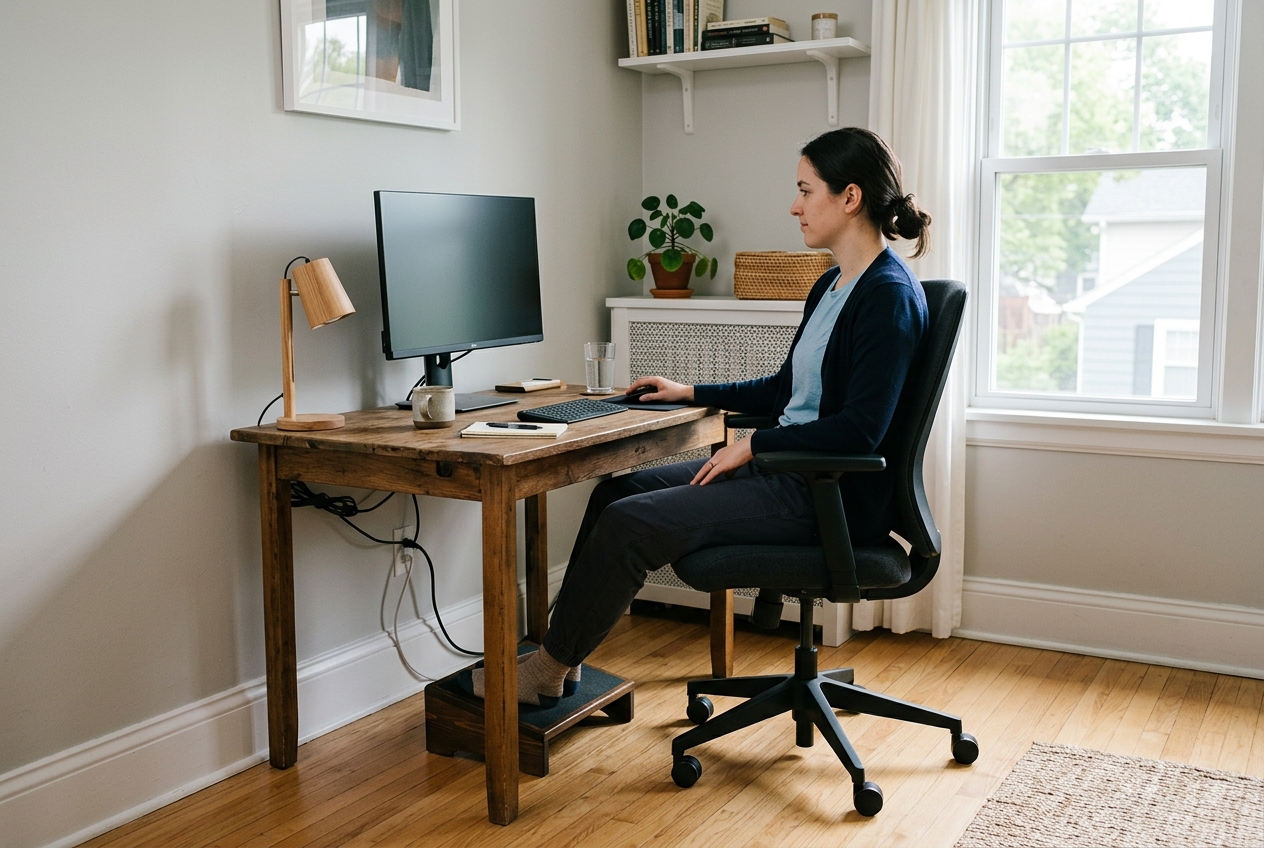
There is no single correct footrest height. The number that works for you depends on two measurements: how high your chair seat sits above the floor, and how long your lower legs are. Raise the chair by an inch and the footrest that fits you changes with it.
That is why so many footrests disappoint people after a week. A 4-inch foam wedge is exactly right for one body and useless for the next. This guide gives you the math, two height charts, and a three-minute way to measure the gap under your own feet before you spend anything.
As an Amazon Associate we earn from qualifying purchases.
The Short Answer: Footrest Height Matches the Gap Under Your Feet
Set your chair correctly first, then measure the empty space between the floor and your soles. That gap is your footrest height. Two conditions have to be true at the same time: your elbows land near desk height, and your thighs sit roughly level with the floor. With a fixed 29 to 30 inch desk, both cannot always happen, and the leftover space under your feet is what a footrest fills.
- Thighs level with the floor keeps your hips supported instead of sliding forward, which takes load off the lower back.
- Soles flat on a surface stops the dangling that causes numb ankles and tight calves by mid-afternoon.
- Measure with the shoes you actually wear. A 1-inch heel changes the number you need.
Typical results land between 2 and 6 inches (5 to 15 cm). Anyone below the 5’4″ mark usually needs the taller end of that range.
Quick Verdict
If you would rather buy than measure, these three cover the useful range. Each one either adjusts or comes in a fixed height that is easy to match against the charts below.
- ComfiLife Foot Rest for Under Desk at Work (two height settings in one foam rest, so you can move up or down a size)
- StrongTek Under-Desk Footrest, 4.5 in High (a firm fixed 4.5 inches in wood for chairs that sit high)
- Everlasting Comfort Foot Rest for Under Desk at Work (soft memory foam for small gaps and bare feet)
Why Footrest Height Is a Math Problem, Not a Shopping Choice
Ergonomics guidance treats the footrest as the last step of a chain: chair height, then desk height, then foot support. When a desk is fixed, the chair has to move, and the chair is what creates the gap. A tall user on a low desk sits with knees higher than hips and needs no rest at all. A 5’1″ user on a 20-inch task chair may have 5 inches of empty air under the soles.
The practical formula is simple arithmetic:
Footrest height = seat height (floor to cushion) − your lower-leg length (floor to the crease behind your knee) + about 1 inch for shoe heel.
Lower-leg length, also called popliteal height, runs roughly 15 to 16 inches for someone 5’2″, 16 to 17 inches at 5’5″, and 17 to 18 inches at 5’8″. If the subtraction gives a number below 1 inch, you do not need a footrest, and buying one will push your knees above your hips.
Footrest Height Chart: Match It to Your Chair
Measure the seat height of your own chair with a tape measure, then read across. These figures assume the chair is set as high as it will go while your forearms still rest comfortably.
| Chair seat height (floor to top of cushion) | Footrest height to aim for | Who usually lands here |
|---|---|---|
| 15-16 in (38-41 cm) | 0-1 in, usually none | 5’0″ to 5’2″ on a compact task chair |
| 17-18 in (43-46 cm) | 1.5-2.5 in (4-6 cm) | 5’3″ to 5’7″ |
| 19-20 in (48-51 cm) | 3-4 in (8-10 cm) | 5’8″ to 6’0″, or shorter legs on a tall chair |
| 21-22 in (53-56 cm) | 4.5-6 in (11-15 cm) | Over 6’0″, or anyone at a fixed dining-height desk |
| 23 in and up (58 cm and up) | 6-8 in, or a foot stool | Small-framed users at a standard 29 in desk |
Read the middle column as a starting point, not a rule. Swap in your own lower-leg measurement and the row stops being an estimate.
Footrest Height for Short People
The query that brings most readers here is simple: what footrest height does a short person need? Short legs plus a standard desk equals the largest gap. Anyone under 5’2″ on a 19-inch seat is often staring at 4 to 6 inches of air, which is taller than most foam cushions on the shelf.
| Your height | Typical lower-leg length | Typical gap under your feet | Footrest height to buy |
|---|---|---|---|
| Under 4’11” (150 cm) | 14-15 in (36-38 cm) | 4-6 in (10-15 cm) | 4.5-6 in, or an adjustable rest at its top setting |
| 5’0″ to 5’3″ | 15-16 in (38-41 cm) | 3-4 in (8-10 cm) | 3-4 in |
| 5’4″ to 5’6″ | 16-17 in (41-43 cm) | 2-3 in (5-8 cm) | 2-3 in |
| 5’7″ to 5’9″ | 17-18 in (43-46 cm) | 1-2 in (3-5 cm) | 2 in, or no footrest |
Two workarounds matter more than any product for this group. Drop the chair until the feet touch, then raise the desk or keyboard instead. If the desk cannot move, a thicker cushion on the seat buys back an inch or two, which lowers the gap without shortening the desk.
How to Measure Your Own Footrest Height in Three Minutes
- Sit back fully. Hips against the backrest, both feet on the floor, shoulders relaxed.
- Find your chair point. Raise or lower the seat until your elbows sit a hair below the desk edge with your forearms parallel to the floor.
- Stack something under your feet. Use a book, a ream of paper, or two cushions. Add or remove layers until your thighs feel level and your lower back settles.
- Measure the stack. That height is your target. Round up to the nearest available footrest size, then fine-tune with tilt or a folded towel.
If your desk has no height adjustment and the stack passes 4 inches, a fixed-height rest will not reach. Look for an adjustable model, a wooden rest, or a foot stool instead.
Adjustable Footrests That Make This Easy
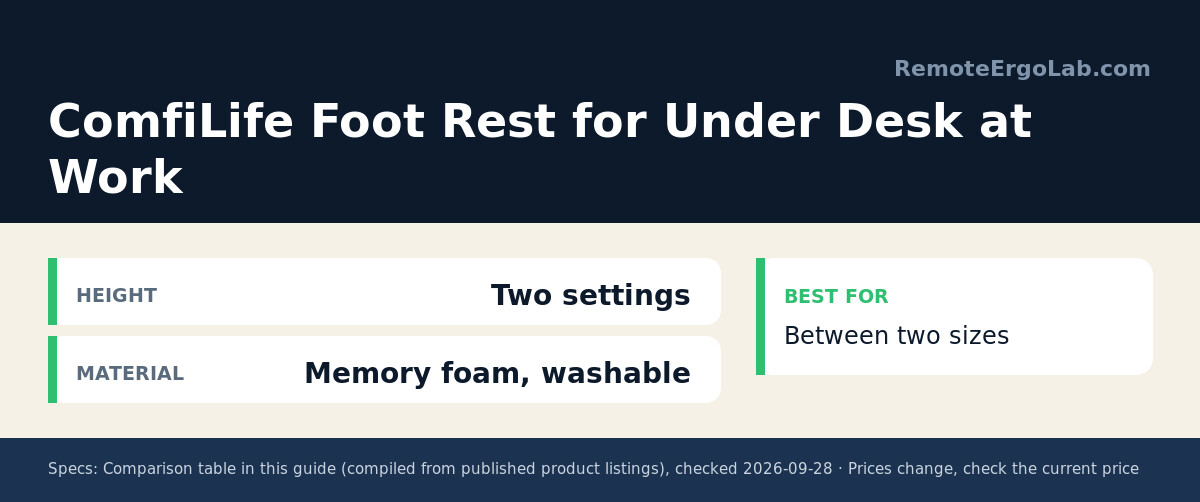
ComfiLife Foot Rest for Under Desk at Work
This one takes the guesswork out of sizing. The ComfiLife foot rest is a teardrop-shaped memory foam block with two height settings, so a user sitting between chart rows can pick the taller option and adjust later. The cover comes off and goes in the washing machine, which matters more than it sounds for a product your feet touch every day. Typical price sits in the $25-$40 band. It suits small and medium frames better than very tall users; check the current price and the listed height before ordering if your gap is above 4 inches.
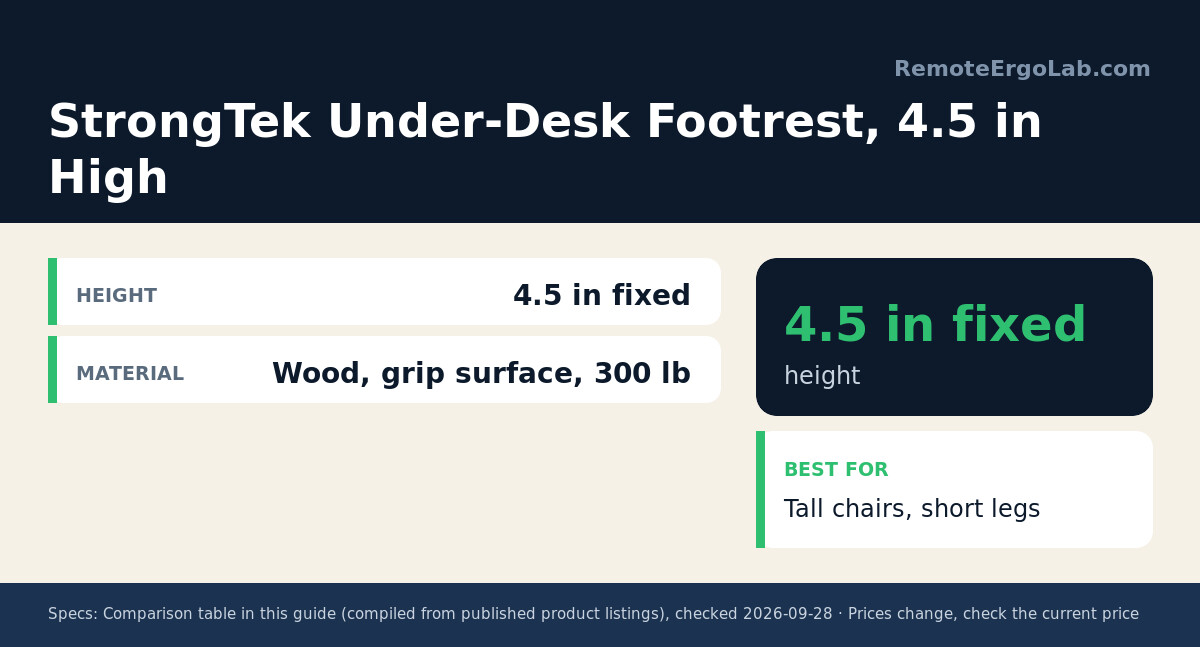
StrongTek Under-Desk Footrest, 4.5 in High
Wood solves what foam cannot. The StrongTek under-desk footrest is a fixed 4.5 inch platform with a textured grip surface and a 300 lb rating, which puts it squarely in the range that short users on standard desks need. It will not compress under a heavy heel the way foam does, and the angled surface doubles as a calf stretcher for tight Achilles tendons. Expect roughly $25-$35. The trade-off is zero adjustability: measure first, because a 4.5 inch block under a 16-inch seat will lift your knees too high.
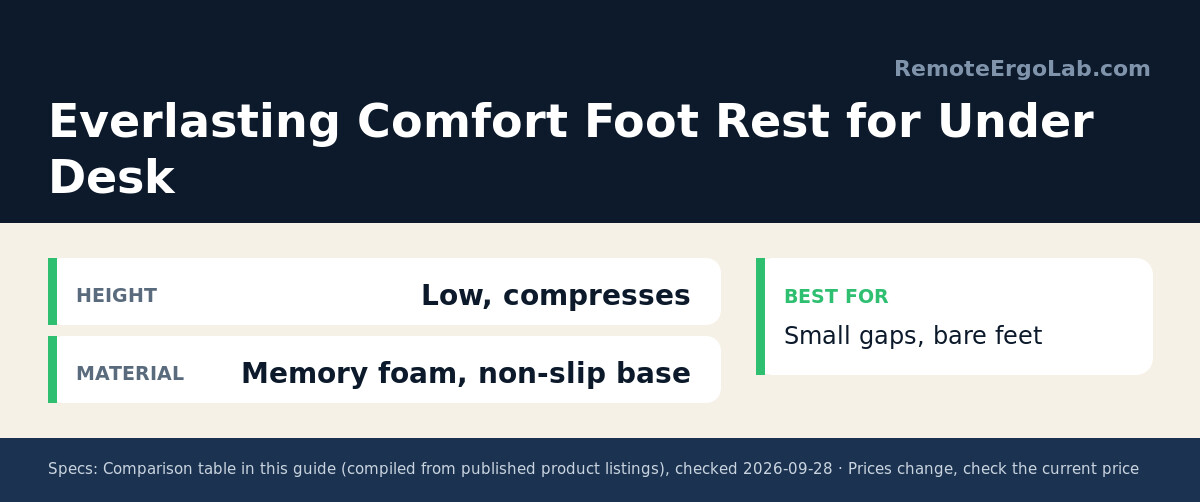
Everlasting Comfort Foot Rest for Under Desk at Work
Softer, lower, and easier on bare feet. The Everlasting Comfort foot rest is memory foam with a non-slip base, shaped to cradle the arches rather than hold a hard edge. The foam compresses under weight, so it works best for gaps of roughly 1 to 3 inches and for readers who want some give under their heels. The non-slip base keeps it in place on hardwood and carpet. Typical price is $20-$35. If you need a rigid 5-inch platform, skip this one and take the wooden rest above.
At-a-Glance Comparison
| Footrest | Height | Material | Best for | Typical price |
|---|---|---|---|---|
| ComfiLife Foot Rest for Under Desk at Work | Two settings | Memory foam, washable cover | Between two sizes | Typically $25-$40 |
| StrongTek Under-Desk Footrest, 4.5 in High | 4.5 in fixed | Wood, grip surface, 300 lb | Tall chairs, short legs | Typically $25-$35 |
| Everlasting Comfort Foot Rest for Under Desk at Work | Low, compresses | Memory foam, non-slip base | Small gaps, bare feet | Typically $20-$35 |
What Else Matters: Tilt, Texture, and Cheap Substitutes
Height decides whether a footrest helps. Three details decide whether you keep using it.
- Tilt. A 10 to 15 degree slope keeps the ankles at a neutral angle and lets the calves relax. Rocking models add movement for restless legs.
- Texture. Smooth leather and PU panels look better; textured wood and mesh foam grip better in socks.
- Substitutes. A ream of paper, a sturdy box, or a stack of hardcover books all work while you test a height. Replace them once the number is settled, because cardboard collapses and books slide.
Nothing here replaces the chair and desk settings above. A footrest fixes dangling legs; it does not fix a seat that is too deep or a monitor set too low.
FAQ
How high should a footrest be for a short person?
For most adults under 5’4″, the right footrest height falls between 3 and 5 inches (8 to 13 cm). Measure the gap under your feet with the chair set to desk height and buy that number, not a round number from a product page.
Should your feet rest flat or at an angle on a footrest?
Flat to slightly tilted is the target. A slope of about 10 to 15 degrees keeps the ankles neutral, while a steep ramp pushes the toes up and tightens the calves.
Can a box or a stack of books replace a footrest?
For a few days of testing, yes, and it is the cheapest way to find your number. Long term, sliding and collapsing make a dedicated rest more comfortable and safer for your ankles.
Does footrest height affect lower back pain?
It can. Feet that dangle pull the pelvis forward and flatten the lower back curve, so supporting them at the right height often reduces the ache that builds over a long sitting block.
What if the height you need is over 6 inches?
That usually means the desk or the chair is the real problem. Options are a taller foot stool, a seat cushion that raises your hips relative to the desk, or lowering the desk and raising the keyboard instead.
Shop These Picks on Amazon
Ready to compare prices? These links open Amazon listings for the specific footrests covered in this guide, so you can check current models and prices yourself. If you buy through them, we may earn a small commission at no extra cost to you – it helps keep RemoteErgoLab free.
- ComfiLife Foot Rest for Under Desk at Work on Amazon
- StrongTek Under-Desk Footrest, 4.5 in High on Amazon
- Everlasting Comfort Foot Rest for Under Desk at Work on Amazon
Related Guides
- Best footrests for short people – fixed-height picks that actually reach the floor gap.
- Under-desk foot hammocks and swing footrests – a different approach when a solid platform feels wrong.
- Best budget under-desk footrests for home offices – four inexpensive models reviewed in detail.
- Standing desk types for small spaces – how desk height options change the whole setup chain.
- Best Under-Desk Bikes 2026: 5 Picks for Remote Workers
- Anti-Fatigue Mats for Standing Desks (2026): 5 Picks
Disclosure
RemoteErgoLab participates in the Amazon Services LLC Associates Program. As an Amazon Associate we earn from qualifying purchases. Prices and availability change constantly, so check the current price on the listing before buying. This guide is based on published ergonomics guidance plus the listed specifications and user reviews of the products covered; no hands-on lab testing is claimed. Nothing here is medical advice.