
A footrest is the cheapest way to fix a desk that sits a little too tall for you. Raising your feet four to six inches takes the weight of your legs off the front edge of the seat, which is what tips you into a slouch after an hour of sitting. Every pick below costs less than a mid-range office chair mat, needs no tools, and is ready the moment you drop it on the floor.
As an Amazon Associate we earn from qualifying purchases.
Quick Verdict
The Everlasting Comfort memory foam footrest suits most people: it works flat, works raised on its base, and flips into a gentle rocker when your ankles stiffen. For a wider stance or extra pressure under the calves, the twin-contour foam footrest gives each foot its own curved surface and a cover you can throw in the washing machine. If you want something firm that refuses to squish, the StrongTek wooden model carries 300 lb on a textured top that doubles as a calf stretcher. Restless feet belong on the wooden rocking footrest, whose angle shifts with light calf pressure and which is rated for 350 lb.
Quick Picks
- Everlasting Comfort Foot Rest for Under Desk at Work – check price (memory foam, works flat or raised, flips into a rocker)
- Foot Rest Under Desk, Ergonomic Memory Foam Under Desk Footrest – check price (twin-contour cushion with a washable zip-off cover)
- StrongTek Under-Desk Footrest, 4.5 in High – check price (solid wood, 300 lb, doubles as a calf stretcher)
- StrongTek Under Desk Footrest, Wooden Rocking Foot Rest, 350 lbs – check price (firmest pick, angle moves with your calves)
How We Chose
Four filters did most of the work, and none of them required hands-on testing. Height came first: a platform between four and six inches covers the gap left by a standard 29 in desk and an average chair, while anything under three inches is barely different from the floor. Second, tilt, because a flat cushion only helps if your ankles already sit at a comfortable angle — a surface that rocks or changes angle keeps the calf muscle moving instead of locked. Third, build and rated load, since foam compresses over months and a wooden platform keeps its shape indefinitely. Fourth, surface grip and care, which decides whether the footrest stays where you put it and whether the cover survives a spilled coffee. Listings whose recent owner notes repeat the same complaint — sliding on hard floors, foam flattening within a year, a top surface that cracks at the edge — were left out.
Comparison Table
| Footrest | Type | Height / adjustability | Best for | Typical price |
|---|---|---|---|---|
| Everlasting Comfort Foot Rest for Under Desk at Work | Memory foam block | Low profile; flat, raised on base, or rocking side | Most desks and most people | typically $30-$40 |
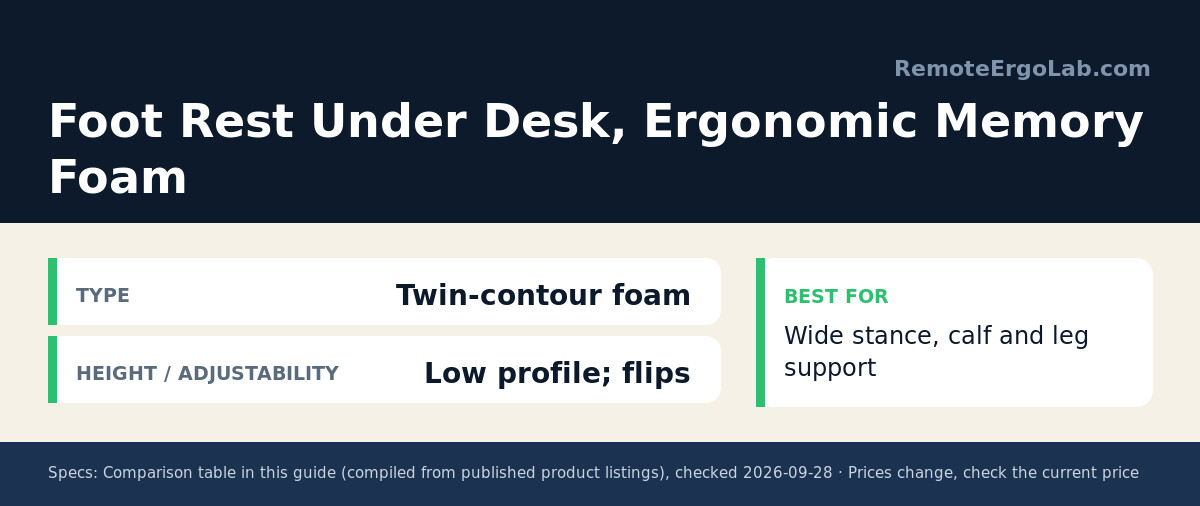
| Foot Rest Under Desk, Ergonomic Memory Foam Under Desk Footrest | Twin-contour foam | Low profile; flips to a rocker | Wide stance, calf and leg support | typically $25-$35 |
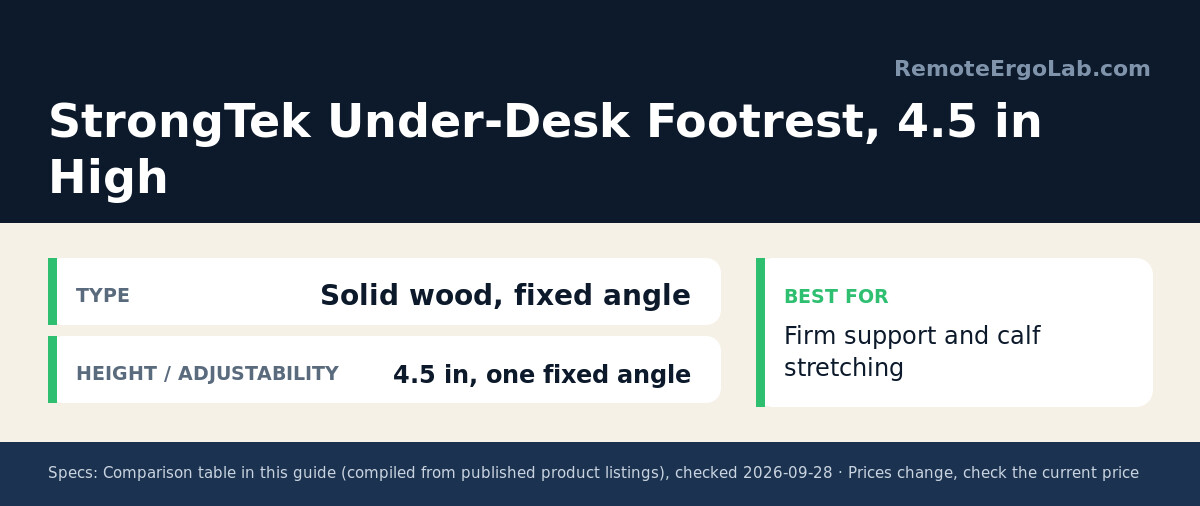
| StrongTek Under-Desk Footrest, 4.5 in High | Solid wood, fixed angle | 4.5 in, one fixed angle | Firm support and calf stretching | typically $30-$40 |
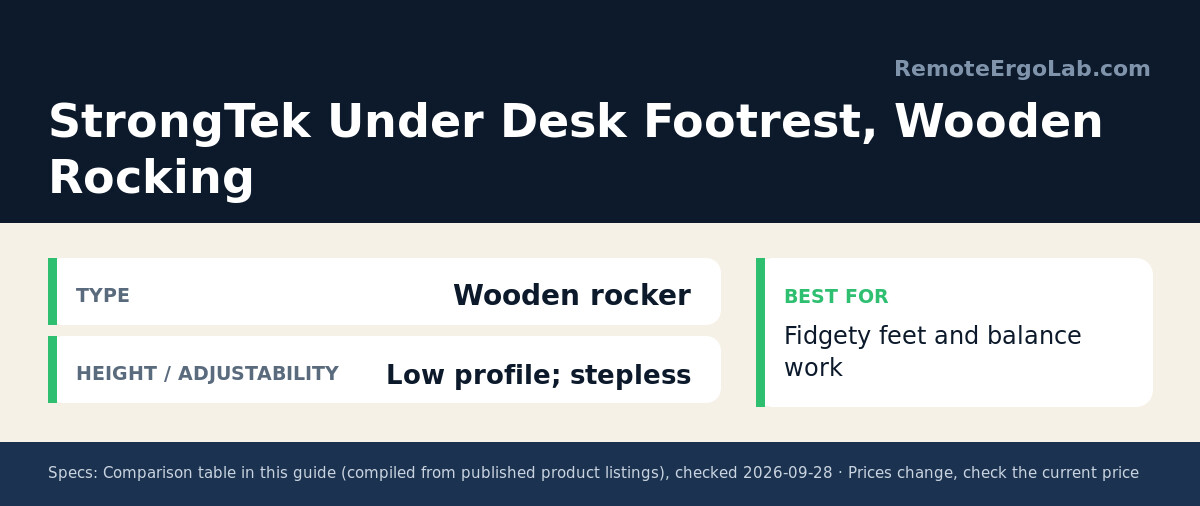
| StrongTek Under Desk Footrest, Wooden Rocking Foot Rest, 350 lbs | Wooden rocker | Low profile; stepless rocking angle | Fidgety feet and balance work | typically $35-$45 |
Amazon prices move around, so treat each figure as a range and confirm the current number on the listing before you order.
Reviews
Everlasting Comfort Foot Rest for Under Desk at Work
This is the safest first buy. The block is built from high-density memory foam rated at 50 on the Shore 00 firmness scale, which lands in the middle of the cushion range: soft enough that your heels sink in slightly, firm enough that the foam does not collapse under the arch. Two shapes come from one product. Leave it flat for steady support, set it across its base for extra elevation, or turn it over and the curved underside becomes a gentle rocker. A non-slip base holds on carpet, tile and hardwood, and the whole thing is light enough to shove aside with one foot when you want to sit cross-legged.
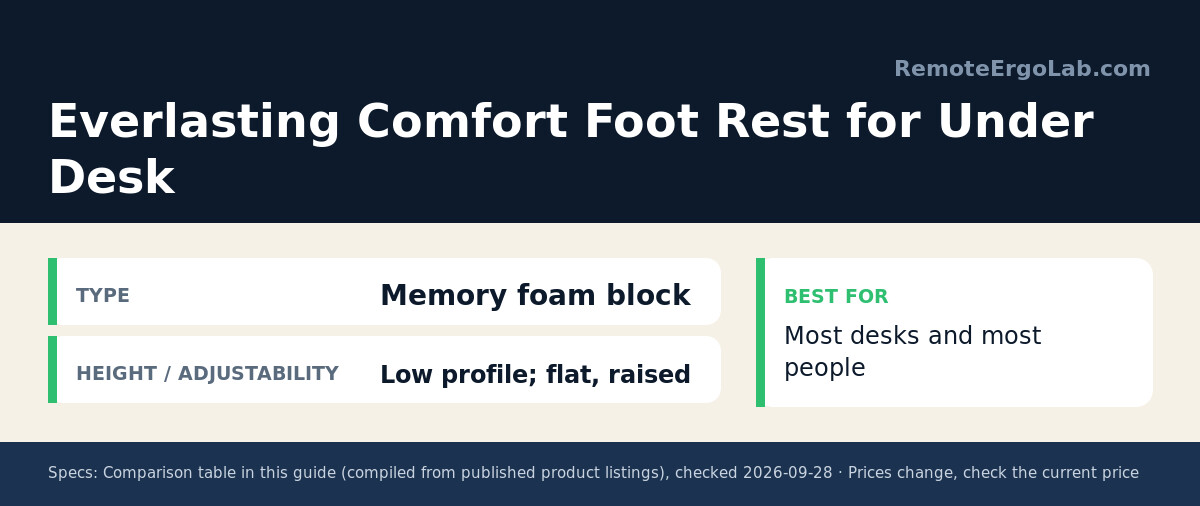
The trade-offs are mild. Memory foam stores warmth, so this one feels less crisp in summer, and there is no height adjustment beyond the two positions built into the shape. For a desk already at the right height, that is plenty.
Foot Rest Under Desk, Ergonomic Memory Foam Under Desk Footrest
Where the Everlasting Comfort model is a plain block, this one is sculpted. The twin-contour top has two separate curved channels, one per foot, so each heel and arch gets its own support instead of sharing a flat plane. That shape suits anyone who sits with feet apart, and it puts pressure under the calves when you flip it over. High-density memory foam does the cushioning, the cover zips off and goes in the washing machine, and a textured bottom keeps the unit from wandering across a hard floor. It also works as a leg or calf rest when you push the keyboard away for a call. Expect a slightly softer feel than the StrongTek boards below, and note that the zip cover needs to be re-seated properly or the top edge bunches.
StrongTek Under-Desk Footrest, 4.5 in High
Wood changes the feel completely. This StrongTek board stands 4.5 in high at a fixed angle, supports 300 lb, and has a textured anti-slip top so socks do not slide off the incline. Nothing compresses, nothing absorbs sweat, and there is no cover to wash. The angle puts your foot into a mild stretch, which is why the listing also markets it as a calf stretcher for tight Achilles tendons and plantar fascia. Compact dimensions mean it disappears under a small desk without eating floor space, and the flat edges make it easy to nudge out of the way. The catch is comfort: bare heels on a hard surface want a thin sock, and there is no squish if you prefer a soft platform.
StrongTek Under Desk Footrest, Wooden Rocking Foot Rest, 350 lbs
Same brand, opposite idea. Instead of one fixed angle, this rocker pivots continuously — you change the tilt by pushing lightly with your calves, which keeps the ankle joint moving rather than parked in one position. The wooden frame is rated for 350 lb, the top surface is grippy, and the arc base stays put on carpet. During breaks you can stand on it for balance and core work, which is unusual for anything in this price bracket. It arrives assembled, so setup is a matter of putting it under the desk. Two honest caveats: the rocking motion is distracting if you are trying to hold a very steady foot position for pedals or a foot switch, and the hard wooden arc can be noisy on bare floors.
Buying Guide
Height: aim for a four to six inch lift
Measure the gap between your heels and the floor while sitting with your hips all the way back in the chair. Most people with a 29 in desk and an ordinary task chair land somewhere between four and six inches, which is exactly the range these cushions and boards cover. Taller desks — 30 in and up — often need a platform near six inches or a footrest placed on a thin riser. If your heels already touch the floor with your knees at roughly 90 degrees, you do not need a footrest at all; spend the money on a mat instead. The arithmetic that turns that gap into a number for your own chair is in our footrest height guide.
Foam, wood or a rolling footstool
Foam cushions win on comfort and lose on longevity — the cheap ones flatten within a year, though high-density blocks such as the Everlasting Comfort pick hold up better. Wood costs about the same and lasts indefinitely, at the price of a firmer feel. A rolling stool with pneumatic height adjustment adds real adjustability, and those models generally start above fifty dollars, which is why they sit outside this list.
Why tilt does more than extra padding
Your calf muscle wants to contract and release. A flat surface holds the ankle in one position for hours, which is why a footrest that rocks, flips or changes angle tends to feel better by the end of an afternoon than a thicker flat cushion. The wooden rocker is the purest version of this idea; the flip-over foam models give you the same benefit without giving up a flat working surface for the rest of the day.
FAQ
How high should an under-desk footrest be?
Four to six inches for a typical 29 in desk with a regular office chair. Sit with your hips back, then measure from the floor to your heels: that distance is the height you want. Anything under three inches rarely changes your posture much.
Is memory foam or wood better for a footrest?
Foam feels softer and absorbs the shape of your foot; wood stays firm, never compresses and is easier to clean. If you sit for long stretches and want pressure spread across the whole foot, choose dense foam. If you want a platform that will look the same in five years, choose wood.
Do footrests help with lower back pain?
They can reduce one common cause. When your feet dangle, your thighs take the load and your pelvis rolls back, which flattens the lumbar curve. Supporting the feet lets the hips settle upright again. That is a mechanical improvement, not a treatment, so persistent pain still deserves a proper look from a clinician.
Can a footrest fix a desk that is too tall?
Partly. A footrest plus a raised chair is the standard workaround for a fixed-height desk that sits high: lift the chair until your elbows are level with the work surface, then give your feet something to land on. Without the footrest, raising the chair just leaves your legs hanging.
How do I stop a footrest sliding on a hard floor?
Look for a textured or rubberised base — all four picks here have one. On very smooth tile, a thin rubber pad under the unit adds grip, and keeping the footrest roughly centred under your chair rather than pushed against a wall stops it creeping forward.
Related Guides
- Footrests for short people — how to size a platform when your chair sits at its lowest setting.
- Under-desk foot hammocks and swing footrests — the hanging alternative if you want your feet off the floor entirely.
- Anti-fatigue mats for standing desks — what to stand on when the desk goes up.
- Best Under-Desk Bikes 2026: 5 Picks for Remote Workers
Shop These Picks on Amazon
Ready to compare prices? These links open Amazon listings for the specific products covered in this guide, so you can check current models and prices yourself. If you buy through them, we may earn a small commission at no extra cost to you – it helps keep RemoteErgoLab free.
- Everlasting Comfort Foot Rest for Under Desk at Work on Amazon
- Foot Rest Under Desk, Ergonomic Memory Foam Under Desk Footrest on Amazon
- StrongTek Under-Desk Footrest, 4.5 in High on Amazon
- StrongTek Under Desk Footrest, Wooden Rocking Foot Rest, 350 lbs on Amazon
Disclosure
As an Amazon Associate we earn from qualifying purchases. RemoteErgoLab is reader-supported: every product in this guide was selected from published specifications and owner feedback, and prices change often, so confirm the current price on the Amazon listing before you buy.