Best Anti-Fatigue Mats for Standing Desks (2026): 5 Picks That Save Your Feet and Back
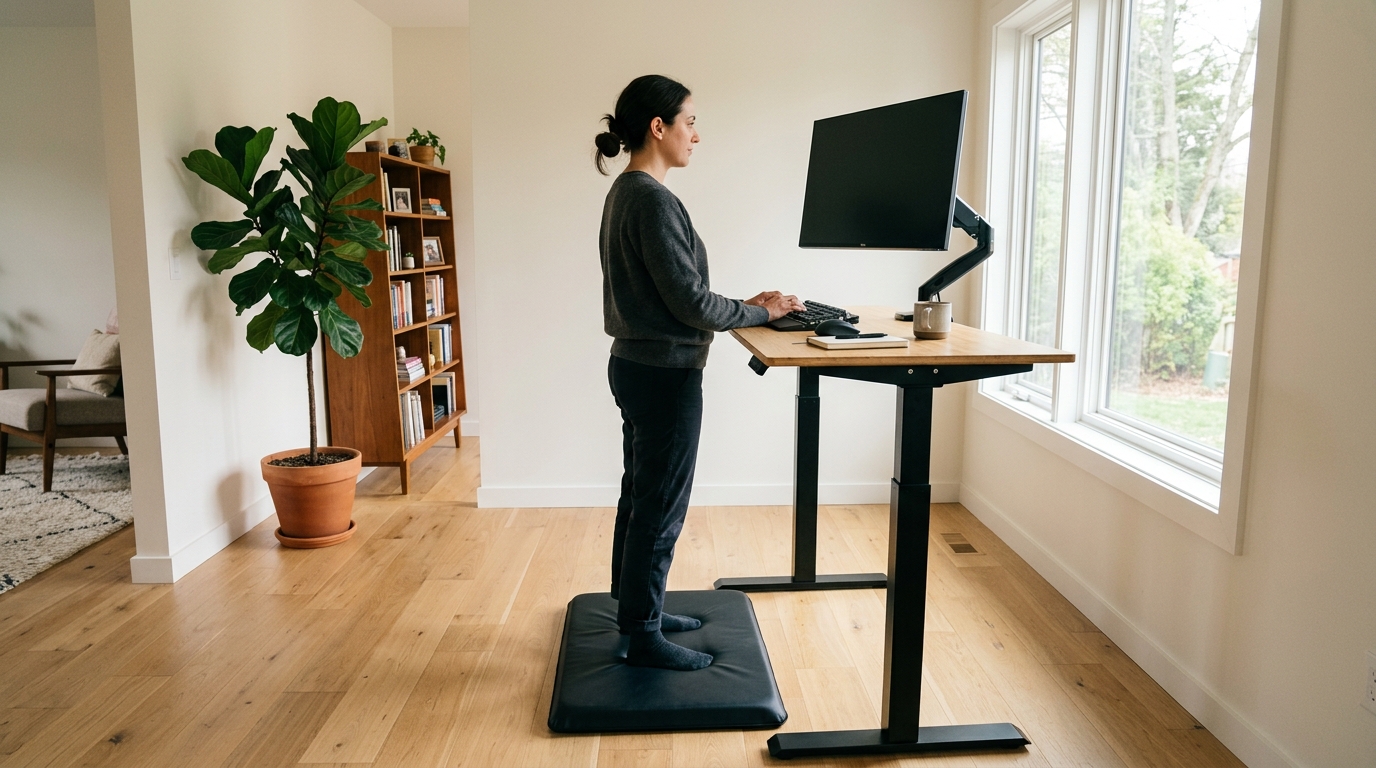
A standing desk without a mat is half a tool. Two hours on hardwood pushes pressure into the heels and arches, and that dull ache is what sends most people back to the chair by mid-afternoon. A good mat adds about 3/4 inch of foam, and the better designs keep your feet shifting instead of locked in one spot. When the ache wins and you sit back down, an under-desk bike keeps your legs moving without leaving the chair.
Quick Answer
A standing desk mat adds about three-quarters of an inch of cushioning between feet and hardwood, spreading pressure across heels and arches to prevent the dull ache that typically ends standing sessions by mid-afternoon. Polyurethane mats resist compression longer than memory foam, while contoured terrain surfaces keep feet shifting position instead of locked in one spot, making standing sustainable for hours rather than minutes.
Five mats earned a place here, judged on thickness, footprint, material, and the complaints that repeat in user reviews. Prices are typical ranges, so check the current price before ordering.
As an Amazon Associate we earn from qualifying purchases.
Quick Picks
- Best overall: The Standing Desk Mat – Topo by Ergodriven — a not-flat terrain surface built to keep you moving.
- Best premium flat mat: WellnessMats Trellis Collection Anti-Fatigue Floor Mat — polyurethane that keeps its support.
- Best memory foam value: Sky Solutions Anti Fatigue Kitchen Mat — 20 x 32 inches, 3/4 inch thick.
- Best budget first mat: Amazon Basics Rectangular Comfort Standing Mat — 32 x 20 inches, black.
- Most popular all-rounder: ComfiLife Anti Fatigue Floor Mat — the 3/4 inch mat in nearly every thread.
How We Chose
Three things decide whether a mat survives daily standing: thickness and density, footprint, and material behavior. Foam that compresses flat within a month is worse than bare floor, and a mat overlapping a desk frame or chair base gets kicked aside. Polyurethane resists compression, memory foam breaks down sooner, and cheap PVC feels hollow within weeks.
Comparison Table
| Mat | Size | Thickness | Material | Typical Price |
|---|---|---|---|---|
| The Standing Desk Mat – Topo by Ergodriven | Square, wider than 20 x 32 in | Ultra-thick | Polyurethane | typically $90-$130, check current price |
| WellnessMats Trellis Collection | 20 x 32 in class | About 3/4 in (1.9 cm) | Polyurethane | typically $130-$190, check current price |
| Sky Solutions Anti Fatigue Kitchen Mat | 20 x 32 in (51 x 81 cm) | 3/4 in (1.9 cm) | Memory foam | typically $40-$60, check current price |
| Amazon Basics Rectangular Comfort Standing Mat | 32 x 20 in (81 x 51 cm) | 3/4 in (1.9 cm) | Foam, textured top | typically $30-$45, check current price |
| ComfiLife Anti Fatigue Floor Mat | 20 x 32 in | 3/4 in (1.9 cm) | Memory foam | typically $45-$65, check current price |
All five sit between 3/4 inch and ultra-thick, the band that changes a long standing session.
The 5 Mats, Reviewed
1. The Standing Desk Mat – Topo by Ergodriven
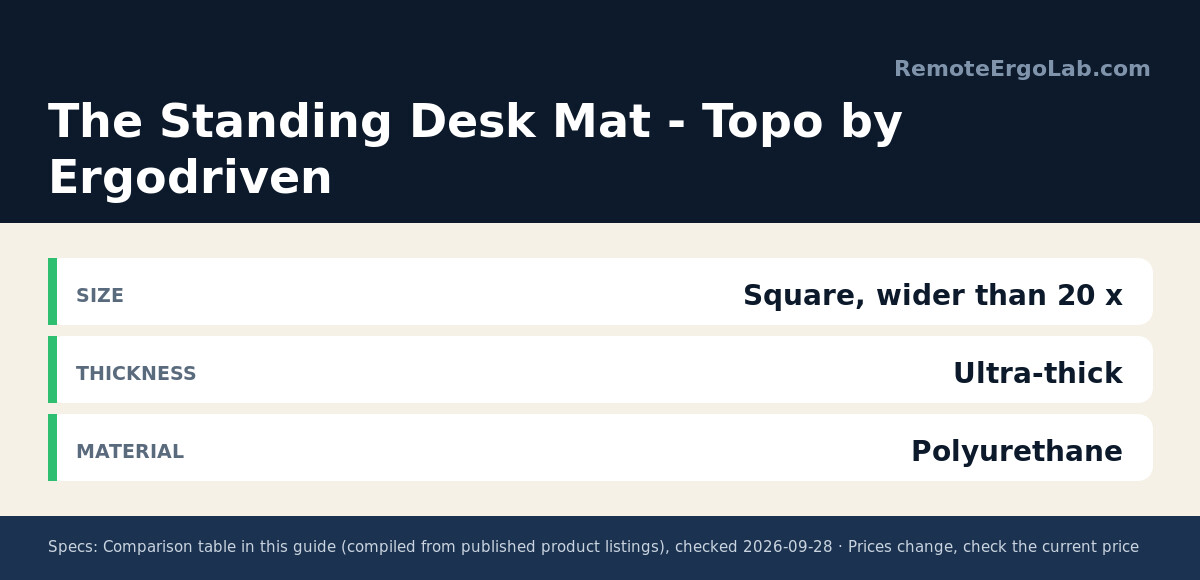
Topo is the odd one out. Instead of a flat rectangle it has a molded terrain surface: a raised dome near the front, side rails, and ridges that invite your feet to move without you deciding to. The foam is non-toxic polyurethane, denser than kitchen-mat memory foam.
Owners call it the mat that makes standing sustainable for an afternoon rather than twenty minutes. Two trade-offs surface: the price, and a footprint squarer than 20 x 32 inches, so measure first.
2. WellnessMats Trellis Collection Anti-Fatigue Floor Mat
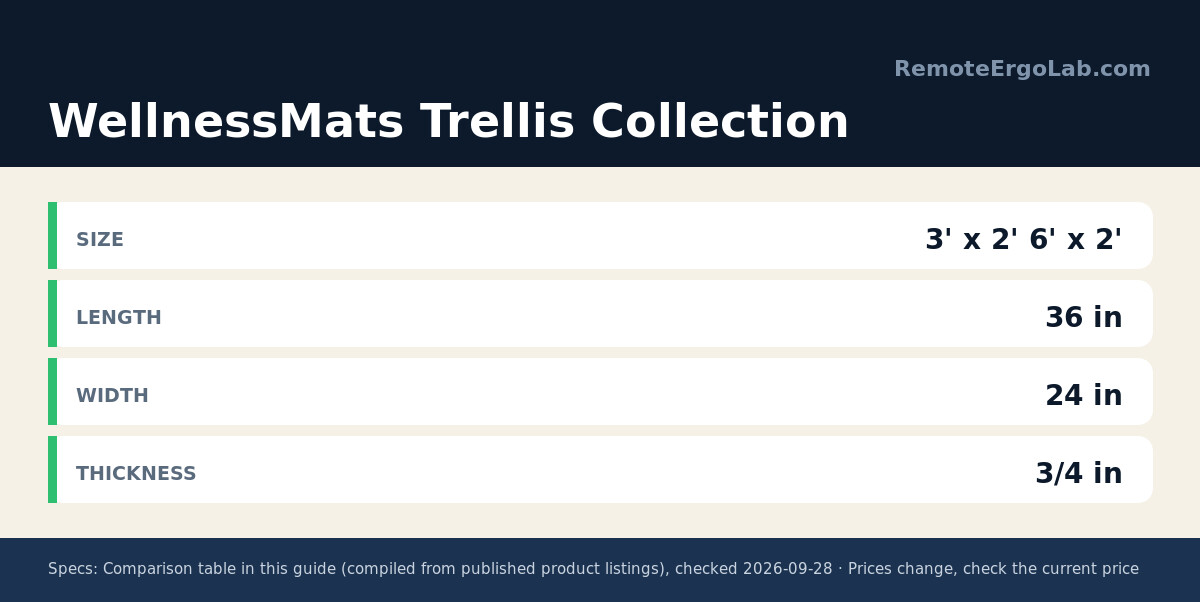
If the priority is a mat that still feels supportive in year three, this is the polyurethane build people buy twice when replacing flattened foam. The surface is water and slip resistant, and wipes clean instead of absorbing spills.
Cost is the catch, typically $130-$190 depending on size, so check current price. Feel is firmer than memory foam: a feature for anyone who dislikes sinking, a drawback in socks.
3. Sky Solutions Anti Fatigue Kitchen Mats (20 x 32 in, Black)
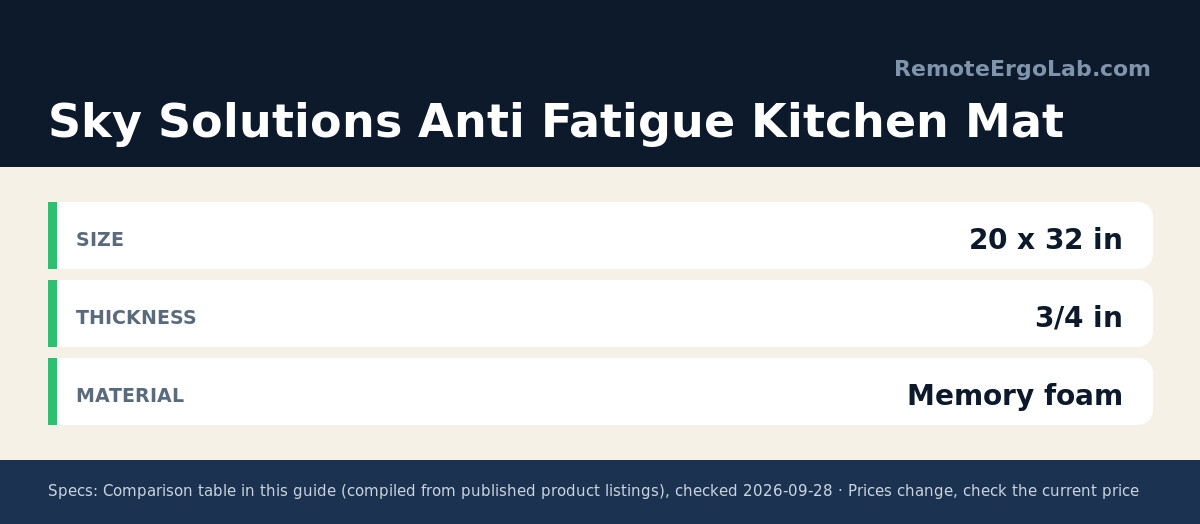
A 20 x 32 inch mat covers 51 x 81 centimeters, enough for a natural stance without swallowing a small office floor. This one is 3/4 inch thick memory foam, waterproof and non-slip, at typically $40-$60.
Buyers wanting softness underfoot are happy, and the size leaves room for a chair to roll past. The recurring complaint is a compressed dip where you stand most, usually after a year of daily use. Rotating the mat 180 degrees every few months is the free workaround owners mention.
4. Amazon Basics Rectangular Comfort Standing Mat (32 x 20 in, Black)
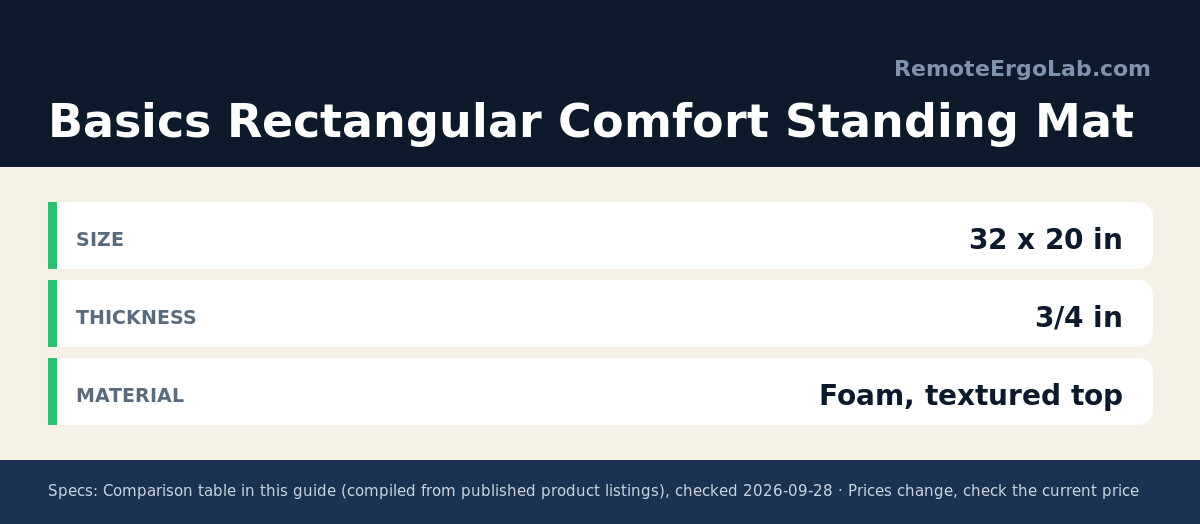
The simplest option here, and the cheapest. Amazon Basics sells it as a 32 x 20 inch rectangle, 3/4 inch thick, black, lightly textured. At typically $30-$45 it costs less than a decent monitor riser, which makes it a low-risk test of whether standing suits your workday.
Firmness is the trade-off: more supportive than plush, so it outlasts soft memory foam, but not pillow-soft. The plain finish hides scuffs wherever the desk shares a room.
5. ComfiLife Anti Fatigue Floor Mat (3/4 Inch Thick)
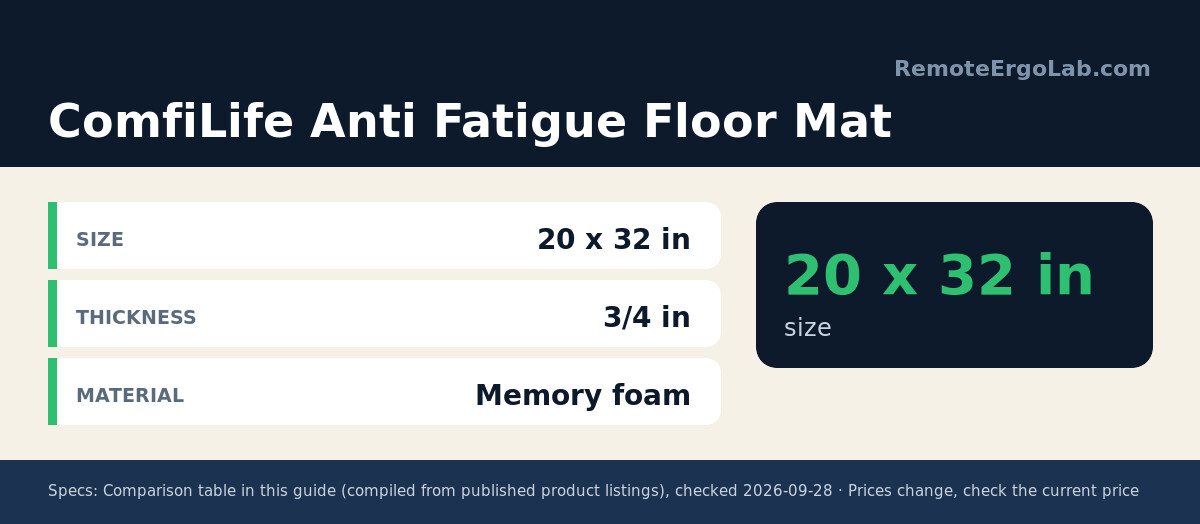
ComfiLife’s 3/4 inch mat is the safe default people recommend to each other: stain resistant, wipe-clean, and sized at 20 x 32 inches, typically $45-$65. The beveled edge means no lip to trip over when you step off mid-task, and the foam gives more than a budget PVC mat.
The textured top does collect sock lint, so a weekly vacuum keeps it presentable.
Buying Guide: What Matters at a Standing Desk
Thickness and density beat softness
Three-quarters of an inch, about 19 millimeters, is the practical baseline. Thinner mats compress to nothing within weeks, and past roughly 1 inch the surface feels unstable when you shift weight. Density outlasts depth: polyurethane beats budget memory foam at the same thickness.
Measure the floor first
Count the space between your desk frame’s feet and the wall. A 20 x 32 inch mat (51 x 81 cm) is the safe default in a tight apartment. If a chair must roll across it, pick a firmer surface, because thick memory foam swallows caster wheels.
Adjust desk height after the mat lands
A 3/4 inch mat raises you about 1.9 centimeters, so add roughly 2 centimeters to your usual desk height to keep elbows near 90 degrees and wrists flat. Saved desk presets make that a few seconds of work.
Beveled edges and barefoot use
A chamfered edge matters for anyone working in socks, since a squared foam lip catches toes and curls at the corners within a season.
FAQ
Is a mat necessary if standing lasts an hour a day?
For one hour, bare floor is survivable. Past 90 minutes, pressure builds on the heels and the lower back starts compensating.
Can a kitchen anti-fatigue mat work at a standing desk?
Yes, and three picks here are sold as kitchen mats. The specs that matter are the same: 3/4 inch of dense foam, a non-slip base, and a footprint that fits your floor.
How do I stop a mat from sliding on hardwood?
Most mats of this type ship with a rubberized underside that grips sealed hardwood and laminate. On tile or a low-pile rug, a thin non-slip pad underneath costs very little.
Does thicker always mean less fatigue?
Only to a point. Cushioning past roughly an inch costs stability, and wobbling while typing is its own fatigue.
Shop These Picks on Amazon
Ready to compare prices? These links open Amazon listings for the specific products covered in this guide, so you can check current models and prices yourself. If you buy through them, we may earn a small commission at no extra cost to you – it helps keep RemoteErgoLab free.
- The Standing Desk Mat – Topo by Ergodriven on Amazon
- WellnessMats Trellis Collection Anti-Fatigue Floor Mat on Amazon
- Sky Solutions Anti Fatigue Kitchen Mats on Amazon
- Amazon Basics Rectangular Comfort Standing Mat, 32 x 20 in, Black on Amazon
- ComfiLife Anti Fatigue Floor Mat 3/4 Inch Thick on Amazon
Related Guides
- Best Footrests for Short People — the seated counterpart.
- Best Budget Sit-Stand Desks — four desks built for daily standing.
- The Complete Ergonomic Home Office Setup Guide — how floor, desk, and chair heights fit together.
- How High Should a Footrest Be? 2026 Height Chart
- Best Under-Desk Footrests Under $50 (2026): 4 Picks
Disclosure
RemoteErgoLab is reader-supported. As an Amazon Associate we earn from qualifying purchases. Our recommendations are based on product specs, published dimensions, and patterns in user reviews, not on personal testing. Prices change frequently, so verify the current listing before you buy.